This essay may come as a surprise to anyone who knew me when I was young, because I am not, historically, a football person. The game I grew up around was an instrument of exclusion, a concentrated dose of everything I struggled with as a kid. I wasn't any good at it, for one, which where I grew up amounted to something close to social death. My parents couldn't afford the Adidas Predators that half my classmates inexplicably wore as school shoes (a sentence that will baffle anyone who didn't attend a British state school in the 90s, and require no further explanation for anyone who did) which marked me out as less well-off in the one currency that mattered in the playground. The stars of the English game at the time were, with dispiriting frequency, racists and domestic abusers; I could never quite look past the awfulness of the men to see the beauty of the game they played, and honestly, I remain a little suspicious of anyone who managed it. I didn't actually watch a match live until my teens, and even then it was while visiting family in America: Watching LA Galaxy against DC United, with my Dad and my uncle, surrounded by elated Mexican families, without a single British gammon in sight. It remains, perhaps tellingly, one of my happiest memories of the sport.
But football has changed in the intervening decades, and I have changed with it. What began as a passing interest in the game's political margins (the discovery of St Pauli, that improbable skull-and-crossbones proof that a football club could stand for something other than its owners' portfolios) accelerated into a quiet fascination somewhere around Leicester City's 5,000-to-1 title win in 2016; an event so statistically offensive that it demanded cultural explanation, which happens to be the only kind I'm qualified to give. There is a professional dimension too, inevitably. I am paid to understand cultures and fandoms, and football is the largest, strangest, most globally distributed fandom our species has ever produced; ignoring it had become a professional dereliction as much as a personal hang-up. So I have been quietly following this World Cup and its cultural meanings, particularly as the (mens) sport breaks through, at last, in the United States; the final terra nullius of the global game, now being colonised with all the subtlety FIFA can muster. Which is to say none at all.
There is a match on Wednesday. England play Argentina in Atlanta for a place in the World Cup final, and if you squint it looks like almost like the platonic ideal of a semi-final; the two most storied rivalries in the international game, Messi's last dance, Bellingham's coronation, sixty years of hurt on one side and the defence of a crown on the other. FIFA's broadcast partners must be weeping with joy. The other semi-final is France against Spain. This is, remarkably, the first World Cup in history in which the four semi-finalists are the four top-ranked teams in the world. What are the odds?
Well, quite. What are the odds?
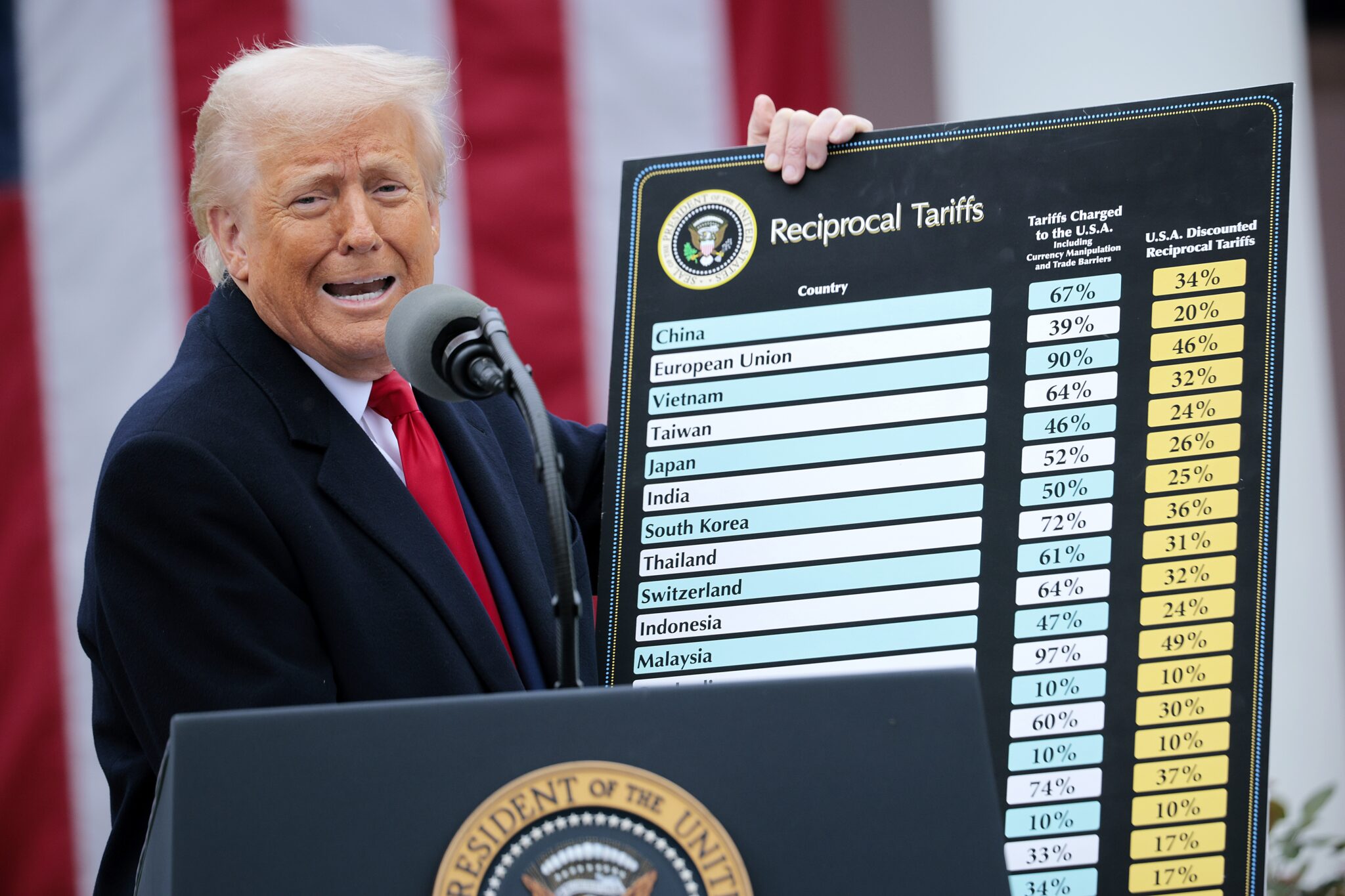
This tournament has been mired in controversy in the way that almost everything FIFA touches is mired in controversy, which is to say structurally, comprehensively, and with a shamelessness that borders on performance art. The president of the United States personally telephoned Gianni Infantino to complain about a red card shown to the USMNT's star striker, and within days FIFA had invoked an obscure provision of its disciplinary code to suspend the suspension. This is a mechanism it had never once used in this manner at a World Cup. UEFA called the decision "unprecedented, incomprehensible and unjustifiable" and said FIFA had "crossed a red line." Belgium's appeal was dismissed on a standing technicality hours before kick-off. Trump, asked about it in the Oval Office, explained that he "didn't think it was a foul" and suggested reporters investigate the referee's past. Trump, of course, is well known for his expertise in the finer points of football. The machinery of sporting justice, it turns out, has a customer service line, and it picks up on the first ring if you happen to be the world's first and only recipient of the FIFA Peace Prize.
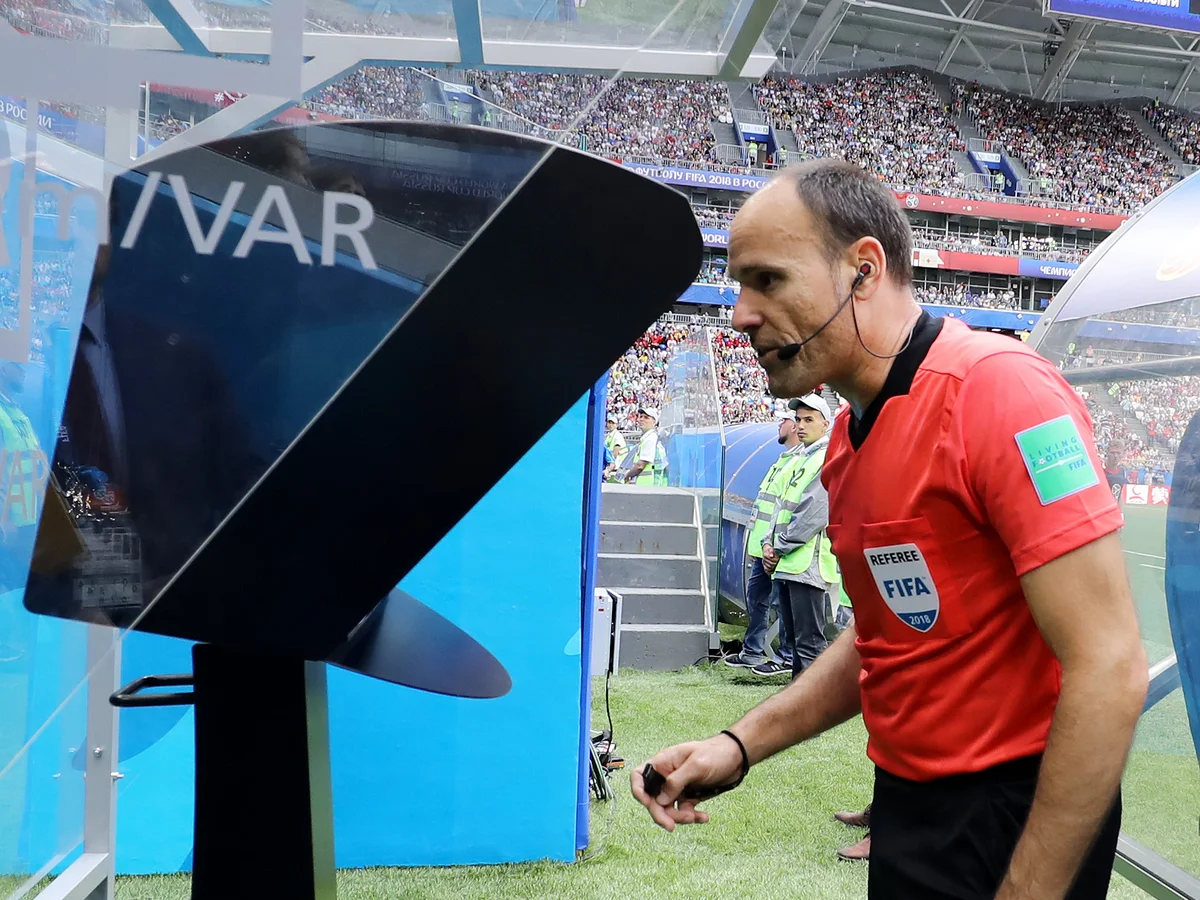
This is, of course, absolutely unsurprising to anyone who has even a passing knowledge of FIFA as an organisation. What caught my attention was a somewhat underreported detail; The on-field referee didn't give a foul when Balogun stamped on Muharemović's ankle. Play continued. Instead, it was VAR that intervened, summoned the referee to the monitor, and produced the red card. The Video Assistant Referee, the great impartial eye, the technology introduced to purge human error from the game. The technology giveth. And then a phone call from the White House taketh away.
Finally! Here is something I know about. A football topic to which I can actually contribute, because I've been writing and studying this for years, in the sense that this is a system of technological adjudication that presents itself as neutral, operates with total discretion, and folds instantly when it collides with actual power.
*
What a magnificent invention VAR is for FIFA. Elite football is a game of fine margins; a toe's width of offside, the interpretation of a shirt-tug, the precise pressure threshold at which contact becomes a foul. VAR gives football's governing body a tool with which those margins can always, always be resolved in the direction of the preferred outcome, and beauitfully, the resolution will always be technically correct.
Everyone who has ever played, watched, or refereed a game, even as appallingly as me, knows the dirty secret of football's laws; every goal is technically disallowable. Every single goal scored from a corner since the invention of the sport involves holding, blocking, pushing, leaning; a forensic enough review will always find the infringement it needs. Extend the review window back through the build-up play (a power VAR formally possesses under IFAB protocol, covering "the period of play before" a goal) and the supply of retrospective fouls becomes effectively infinite. The question is never whether an infringement exists, but rather is whether anyone chooses to look for it.
This tournament has been an extended demonstration of that discretion in action. Egypt, leading the world champions 2-0 in the last sixteen with half an hour to play, had Mostafa Zico's goal chalked off when VAR excavated a foul in the build-up; a shirt-hold and a trodden foot, the kind of contact that occurs a dozen times in any given match without comment. Commentators on the broadcast said flatly that the review was beyond VAR's remit. It wasn't, quite; that's the point. The protocol is elastic enough that it was technically permissible, and technically is the only tense in which VAR ever speaks. Late in the same match, Salah's appeals for a foul in the move that led to Argentina's winner went unreviewed. Jamie Carragher observed that in any major league the Egypt goal would have stood; Ian Wright noted the asymmetry with the bluntness it deserved: if you pull one back, you pull them both back. Egypt's federation filed an official complaint. Argentina marched on to a quarter-final against Switzerland, who then spent fifty-plus minutes with ten men after Breel Embolo was shown a second yellow for diving, and duly went out in extra time.
Meanwhile Brazil had a Vinícius Júnior goal disallowed against Scotland for a foul so soft that the Brazilian federation wrote formally to FIFA requesting "consistent application of VAR intervention standards." Ghana were denied a penalty against England when Ezri Konsa lunged through Prince Kwabena Adu's knee without touching the ball; VAR, in Carlos Queiroz's imperishable phrase, "went for a coffee." Germany had an extra-time goal ruled out for a phantom block that even sympathetic analysts concluded should have stood. Each individual decision, taken in isolation, can be defended. There is always a clip or a freeze-frame or a clause. This is exactly what makes the system so useful; a technology that can justify anything justifies nothing. What it does is legitimates everything.
To be clear: I am not asserting that a FIFA official sits in a bunker in Zurich directing outcomes like a Bond villain; though given this organisation's rap sheet, from the 2015 DOJ indictments to the Qatar vote, you would be a fool to rule it out on character grounds. What I am saying is both a little more modest and a little mode damning: the system has been architected such that a manipulated tournament and an honest one are observationally identical.
Every intervention is deniable. Every non-intervention is defensible. The referees are appointed by the body with the commercial stake in the outcome; the review thresholds ("clear and obvious error") are subjective by design; the deliberations happen in a sealed booth whose audio FIFA declines to publish. When the world's four most bankable football nations arrive in the semi-finals of the most commercially leveraged World Cup ever staged, having benefited from a seeding system openly redesigned to keep them apart until now and a review system whose grey areas broke their way with suspicious regularity, you do not need to prove a conspiracy. The absence of any means to disprove one is the scandal.
Never again will we see a Greece 2004. Never again the anarchic, ungovernable tournament where the wrong team wins. Not because upsets have been outlawed, but because the margins that upsets live in ( that is, the soft penalty survived or the marginal offside waved on or the red card not given) are now administered, centrally, by the party with the most to lose from them.
*
In 1980 the philosopher Langdon Winner published an essay whose title has become a kind of shibboleth in science and technology studies: "Do Artifacts Have Politics?" His most famous example, the low-hanging parkway bridges of Robert Moses' New York, allegedly built to keep buses (and therefore the poor) away from Jones Beach, has been picked over and partially debunked in the decades since. That said, the essay's core insight has only hardened with age. Technologies are not neutral instruments that arrive innocent into the world to be used well or badly, but rather they embody arrangements of power. They settle, in steel and code and protocol, questions about who decides, who benefits, and who must simply endure the consequences; and they settle those questions in ways that are far harder to contest than a law or a policy, because a technology does not look like a decision. It looks like the way things are.
VAR is a Winner artefact par excellence. What does the technology actually consist of, materially? A bank of screens, a private room, a closed communication channel, an appointed official, and a protocol written and interpreted by FIFA. The camera may be neutral but literally nothing else in that room is. What VAR did was take the discretion that previously lived on the pitch (visible, embodied, accountable in real time to 80,000 witnesses) and relocate it to a sealed booth staffed by appointees of the governing body, operating under rules that body writes, reviewing footage that body controls. This was described, universally, as removing human error from the game, yet it removed nothing; it moved the human judgement somewhere you can't see it, and draped a camera over the door.
The historian of science Theodore Porter gave us the best account of why this move works so reliably. In Trust in Numbers, Porter traces how quantification and mechanical procedure became the dominant language of institutional legitimacy; not because numbers are truer than judgement, but because they perform impartiality. "Mechanical objectivity," in Porter's phrase, is what institutions reach for when they are weak, distrusted, or under scrutiny: a way of saying it wasn't me, it was the method. The critical insight is that mechanical objectivity is a strategy of the distrusted. Institutions with meaningful authority exercise judgement openly, and institutions haemorrhaging legitimacy hide their judgement inside procedures, instruments, and metrics, where it can no longer be argued with. It is not a coincidence that football adopted VAR in the immediate aftermath of the great FIFA corruption scandals of the mid-2010s. An organisation whose executives were being led out of Zurich hotels in handcuffs needed, urgently, a technology of trust. It found one, in a machine for converting contestable judgements into apparent facts.
The facts are far, far less factual than they appear. Harry Collins and Robert Evans wrote the definitive book on this, Bad Call: Technology's Attack on Referees and Umpires and How to Fix It. Its central finding deserves to be tattooed on the forearm of every football administrator; measurement technologies in sport systematically present estimates as certainties. Hawk-Eye does not show you where the ball was; it shows you a reconstruction, with error margins that the broadcast graphic quietly omits. Semi-automated offside does not reveal that a striker's backside was two centimetres beyond the last defender at the moment of release; it models it, with tolerances in frame-rate and limb-tracking that would make any honest metrologist blush, and then renders the model as a crisp 3D animation whose visual authority forecloses dissent. Collins and Evans call this false transparency: the interface performs a precision the instrument does not possess. Iran discovered this in the group stage, when Mehdi Taremi's late winner against Egypt was erased because his backside was marginally offside; a decision that took an eternity to produce and was then displayed to the stadium as though it were a reading from nature. Cricket, to its credit, at least encodes epistemic humility into its review system: the "umpire's call" provision explicitly acknowledges that within the technology's margin of error, the human's original judgement stands. Football chose the opposite design, and clearly that choice was political.
*
If VAR were an isolated case, this would be a piece about football. It is decidedly not an isolated case. In my opinion, as someone who knows a lot about technology and only a little about football, It is just one instance of the defining institutional manoeuvre of our era: the deployment of technologies that carry the prima facie appearance of fairness, objectivity, or equity, and that function in practice as machinery for extending and laundering the power of whoever operates them. Once you see the pattern, you cannot stop seeing it.
My first thought as I watched the USMNT aftermath unfold was the Post Office Horizon scandal, plausibly the most extensive miscarriage of justice in British history. Between 1999 and 2015, more than nine hundred subpostmasters were prosecuted for theft and false accounting on the evidence of Fujitsu's Horizon accounting system; a system riddled with bugs that the Post Office knew about and concealed. The prosecutions were possible because English law had, since 1999, operated a presumption that computer evidence is reliable; the machine's word was taken over the human's, structurally, by default. People went to prison, bankrupted, and at least four took their own lives. The computer was decidely not neutral; it was an instrument wielded by an institution that preferred prosecuting its own workforce to auditing its own software, and the presumption of mechanical reliability was the weapon's edge.
What about Ofqual's 2020 grading algorithm, which took the exam results denied to pupils by the pandemic and replaced them with statistical predictions anchored to each school's historical performance? The effect, foreseeable and foreseen, was to downgrade bright pupils from large state comprehensives while protecting the grades of small private-school cohorts, whose class sizes exempted them from the model. The algorithm did exactly what it was designed to do: preserve the distribution, which is to say, preserve the hierarchy. It took teenagers who had escaped their postcode's statistical destiny and returned them to it. Only when the results provoked street protests did Boris Johnson disown the "mutant algorithm"; a phrase that performed the second great function of these systems, which is blame absorption. The algorithm did not mutate, that is patently absurd and I feel embarrassed even writing it down. It was commissioned, specified, and signed off. Mutation was a story told afterwards, so that no minister had to own the design.
What about Robodebt, Australia's automated welfare debt recovery scheme, which averaged annual income across fortnights to conjure debts that did not exist and then reversed the burden of proof onto welfare recipients to disprove them? Nearly half a million people were pursued for phantom debts in a a scheme was unlawful from inception; the government's own advice said so, but it ran for years anyway, because it was profitable and because the algorithm provided a procedural fog behind which the cruelty could be administered at scale. The subsequent Royal Commission described it as a "crude and cruel mechanism, neither fair nor legal." What about the Dutch toeslagenaffaire, in which the tax authority's fraud-detection algorithms flagged tens of thousands of families (disproportionately those with dual nationality, which the system treated as a risk indicator) as childcare benefit fraudsters, clawing back tens of thousands of euros per family, destroying lives with such administrative thoroughness that in 2021 the entire Dutch government resigned over it. what about COMPAS, the American recidivism-prediction tool that ProPublica found produced false positives for Black defendants at roughly twice the rate it did for white ones, and whose vendor's defence (that the tool was calibrated fairly by its own chosen metric) inadvertently proved the deeper point: "fairness" in these systems is a design parameter, selected by the owner, optimised for the owner's definition.
And then there's algorithmic management. You might well know this pattern intimately, and if you don't, you will. The Uber driver deactivated by a fraud-detection model with no appeal to a human; the Deliveroo rider whose "statistics" quietly determine access to shifts; the warehouse worker paced by a rate-setting algorithm tuned to the edge of physical endurance. Two decades of critical labour scholarship, from Braverman's deskilling thesis onward, taught us that management technologies serve to relocate knowledge and discretion from the shop floor to the office. The algorithm perfects the move and then adds the alibi: the system flagged you, the system set the rate, the system is very sorry but there is nothing anyone can do. Dan Davies, in The Unaccountability Machine, calls this the accountability sink, an arrangement deliberately constructed so that when something goes wrong, there is no human to whom responsibility attaches. The algorithm is the perfected accountability sink. It makes decisions no one made.
*
Line these cases up next to VAR and the mechanism is clear. Technologies of ostensible fairness, deployed by self-interested institutions, perform three moves with remarkable consistency.
First, they relocate discretion out of sight. The judgement doesn't disappear so much as it migrates from a visible, contestable human context (the referee on the pitch or the teacher's predicted grade, or the caseworker's assessment) into a booth, a model, a scoring function, where it is exercised by fewer people, under less scrutiny, with more power. Michael Power called the broader phenomenon "the audit society": rituals of verification that produce comfort rather than knowledge, and that transfer authority to whoever controls the ritual.
Second, they convert contestable judgements into apparent facts. This is Porter's mechanical objectivity fused with Collins and Evans' false transparency. The 3D offside graphic and the credit score and the risk rating and the debt figure on the automated letter. Each takes a decision saturated with assumptions and renders it in the visual and rhetorical language of measurement. You can argue with a referee, but you cannot argue with a line on a screen, even when the line is a guess wearing the trappings of science like a fraud in a lab coat.
Third, they provide deniability. When the outcome favours the powerful, it was simply what the technology found; technically correct, the best kind of correct. When the outcome provokes outrage, the technology absorbs the blame; mutant algorithm or a regrettable system error or a VAR official who has been quietly stood down for the next round. Either way, the institution that designed, procured, and operated the system walks away clean. Infantino's statement on the Balogun affair was a masterclass in the genre: FIFA's judicial bodies are independent, they operate autonomously, he is himself sometimes surprised by them. The president of the organisation, describing its disciplinary machinery as weather.
The naive question to ask of any such technology is this: does it work? Does VAR get decisions right? Is the algorithm accurate? This is the question the vendors and the governing bodies are delighted to debate, because it concedes everything that matters.
The correct questions are the old Luddite questions. These are the ones I keep returning to in these pages because they keep being the right ones. Who does this technology work for? Who decided to deploy it, under what conditions, with what powers of oversight? Whose discretion does it expand and whose does it extinguish? The original Luddites, remember, were not opposed to machinery; they were opposed to machinery deployed under social relations that served capital at the expense of craft and livelihood. VAR is not a bad technology. VAR under FIFA is a bad social relation.
*
The proof that VAR's opacity is a choice rather than a necessity is that other sports chose differently. Cricket broadcasts the DRS review live, third umpire's reasoning and all, and encodes measurement uncertainty into the umpire's-call rule. Rugby union puts the TMO's deliberations on the stadium speakers; you hear the officials reason their way to a decision, disagree, persuade one another. These systems are imperfect and still contested (all officiating is), but they treat the audience as citizens of the sport rather than consumers of a verdict. Football, alone among the major sports, sealed the room. Football, alone, is run by FIFA. I leave the inference as an exercise to the reader.
An honest VAR would publish the audio of every review, in full, within the hour. It would place video officiating under a body institutionally independent of the tournament's commercial owner, with appointments and performance data in the open. It would display error margins on every offside graphic and adopt something like umpire's call for decisions within the tolerance. It would define, publicly and exhaustively, the conditions under which build-up play can be reviewed, so that the retrospective-foul lottery ends. And it would enshrine in statute what the Balogun affair violated: that no output of the disciplinary system can be reversed by executive discretion, whatever head of state happens to be on the phone.
None of this is technically difficult. All of it is politically impossible under the current ownership, and that impossibility is the diagnosis. FIFA does not want a trustworthy system; it wants a trusted one, and the gap between those two words is where the power lives. The same gap yawns beneath the credit score and the content moderation appeal and the automated benefits decision and the AI hiring filter; every system that asks for your faith while refusing your scrutiny.
So: England v Argentina, Wednesday, in Atlanta. I'll watch it and I'll be on my feet if Bellingham score, and the part of me that came to this game late enough to choose it rather than inherit it will believe. But somewhere in that stadium there is a sealed room, and in that room there are screens, and in front of those screens sit people I did not choose, applying rules I cannot fully see, on behalf of an organisation whose interests are not mine, empowered to find (technically, always technically) whatever the moment requires. And that should alarm us all.